- Used only for air-bending deformation technique
- Only theoretical values - for more realistic values please use the manual of your press brake or CNC software calculations
- This calculator just for main information - no responsibility for information use and possible problems
- You can use and input manually tensile strength for non-indicated materials
- Recommended die opening V - general sizes available for dies on the market as standard. Sometimes use of customized and special die opening could be more effective
- Parameter Fm - just to indicate force/meter which is important for bending tooling choose
- Switch between mm and inches. Possibility to input inches values as XX,XX or X/X
Press brake air bending force and tonnage calculator
This is our calculator to calculate the force of press brake necessary for your application.
Metric
Inch
Recommended V: - mm
Internal radius R: 0 mm
Minimal flange h: 0 mm
Bending force F: 0 metric tons
Bending force per meter Fm: 0 metric tons/m
K-factor K: 0
K-factor source: -
Bend allowance BA: 0 mm
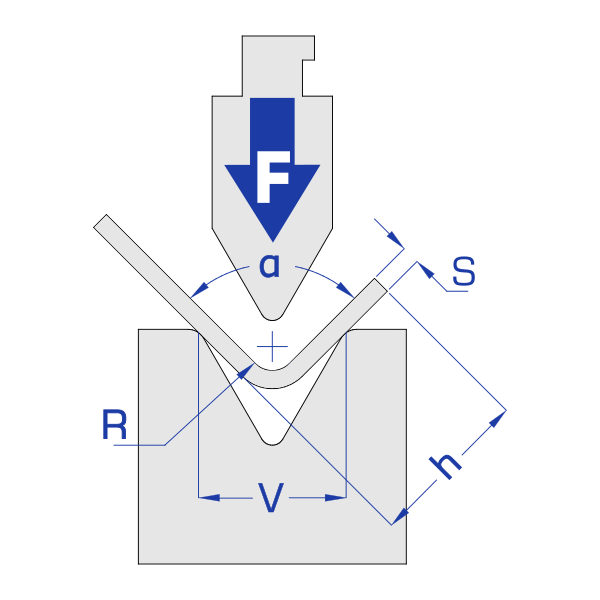
Formulas used
- Calculation of V-die opening (parameter V):
V=S*6 for thickness less 0,7 mm;
V=S*8 for thickness 0,71 - 6 mm;
V=S*10 for thickness 6,01 - 10 mm;
V=S*12 for thickness 10,1 - 14 mm;
V=S*14 for thickness from 14 mm and higher - Calculation of internal radius (parameter R): R = (5*V)/32
- Calculation of minimal flange (parameter h):
30° - h = 2*V
45° - h = 1,38*V
60° - h = 1,06*V
90° - h = 0,78*V
120° - h = 0,64*V
135° - h = 0,60*V
165° - h = 0,56*V - Calculation of bending force (parameter F): F = (1,42 * TS * (S*S) * L)/(1000*V)
Force is calculated in kN and divided by 9.80665 to get metric tons.
Attention that all calculations even in inches values are for metric tons, not for US short tons. - Calculation of K-factor (parameter K):
Aluminium alloys (TS ≤ 310 N/mm²) - K = 0,33
Mild steel (S235 / S355) (TS ≤ 430-550 N/mm²) - K = 0,42
Stainless steel AISI 304 (TS 650 N/mm²) - K = 0,45
Stainless steel Duplex 2205 (TS 880 N/mm²) - K = 0,47
For manual inserted materials:
TS ≤ 350 N/mm² - K = 0,33
TS 351 – 520 N/mm² - K = 0,42
TS 521 – 750 N/mm² - K = 0,45
TS > 750 N/mm² - K = 0,47 - Calculation of Bending Allowance (parameter BA): BA = (π/180) * (180-A) * (R + K * S)
π usually also knows as Pi is often approximated as 3,14
Bending allowance formula is according to basic formula from DIN 6935
Minimal flange (h)
Minimal flange length is important parameter which should be verified before the bending. With the small flange less than minimal the part could be falled inside the groove of V-die so the minimal flange directly depends of the opening of V-die to stay during the end of the bend on the both shoulders of the die. In some sources it is possible to find the information about the dependance of the minimal flange based on the material thickness (4-5 times as minimal) but such calculation cannot be done without verification of the die size. The smaller flanges as recommended are possible to obtain with roller dies or special tools.
Some sources recommend to determine the material minimal flanges based on the positioning of flat material on the die to the end of the opening + 20% more. So it means for V=50 die the material part after the center of the bending should be 25 (distance from center) + (20% of 50) = 35 mm. We do not recommend this calculation because necessary to considerate also the die shoulder radius for verification.
Some sources recommend to determine the material minimal flanges based on the positioning of flat material on the die to the end of the opening + 20% more. So it means for V=50 die the material part after the center of the bending should be 25 (distance from center) + (20% of 50) = 35 mm. We do not recommend this calculation because necessary to considerate also the die shoulder radius for verification.
Internal radius (R)
Internal radius is the parameter to obtain based on the V-die opening size. For development for any sheet metal bending minimal internal radius recommended to project not less than the material thickness. This calculator doesn't show any connection to the radius of the punch (upper tooling) but it is important to note that if the radius of the punch will be bigger than internal calculared radius - the radius of the punch should be considered as obtained. This calculation doesn't work with special materials where the recommendation could be to bend with 1,5-2 times of thickness of the material for internal radius. Moreover special recommendations could be done for aluminium to prevent the cracking of the material.
This calculation is not used for radius bending. For radius bending theoretical formula to be used should be: V-die size (parameter V) = 2*R + 2*S, so to achieve R50 internal radius on the part it is necessary to use V-die not less than 50*2 + 2 of material thicknesses and angle of the die less than ~70 degrees to do the overbending to prevent the springback.
This calculation is not used for radius bending. For radius bending theoretical formula to be used should be: V-die size (parameter V) = 2*R + 2*S, so to achieve R50 internal radius on the part it is necessary to use V-die not less than 50*2 + 2 of material thicknesses and angle of the die less than ~70 degrees to do the overbending to prevent the springback.
K-Factor (K)
The K-factor is a dimensionless coefficient used in sheet metal bending calculations to define the position of the neutral axis within the material thickness during deformation. The K-factor is essential because it directly determines Bend Allowance (BA) and Bend Deduction (BD). Even small changes in K-factor can significantly affect final part dimensions in precision sheet metal fabrication. The K-factor depends on process conditions such as material type and it's tensile strength, thickness, inside bending radius etc.
Bending Allowance (BA)
Bend allowance is the length of material required to form a bend in a flat pattern, measured along the neutral axis of the material. It represents the portion of the flat blank that will be deformed into the curved bend during forming, and it becomes the arc length of the neutral axis after bending.
In a flat pattern, bend allowance is the segment between the straight flange lengths. These straight sections remain undeformed, while the bend allowance segment is “consumed” to create the bend geometry. After forming, this length no longer appears as a straight segment, but instead exists as the curved portion of the bend.
Bend allowance is used in engineering design to calculate the correct flat blank dimensions from a finished part model, ensuring accurate manufacturing of sheet metal components.
We do not use Bend Deduction term on our calculation as other way to determine exact lenght of the complete flat part.
In a flat pattern, bend allowance is the segment between the straight flange lengths. These straight sections remain undeformed, while the bend allowance segment is “consumed” to create the bend geometry. After forming, this length no longer appears as a straight segment, but instead exists as the curved portion of the bend.
Bend allowance is used in engineering design to calculate the correct flat blank dimensions from a finished part model, ensuring accurate manufacturing of sheet metal components.
We do not use Bend Deduction term on our calculation as other way to determine exact lenght of the complete flat part.